New Zealand Is Trying to Tax the Offshore Casinos It Spent Twenty Years Ignoring
 Chloe O'Sullivan
A licensing auction, a tax fight, and three pending lawsuits collide as the country tries to bring its gray-market online casino habit onshore.
New Zealanders have gambled on offshore casino websites for two decades, and until this year, none of it broke the law. New Zealanders sent an estimated NZ$1.36 billion (US$758 million) into online casino and gambling accounts between October 2023 and September 2025, according to Department of Internal Affairs (DIA) data released as the government built its new licensing system. Their deposits mostly missed Wellington's tax office, with roughly 96.3% of that money landing at casinos licensed in Malta, Gibraltar, Cyprus, or Great Britain, per the DOT Loves Data study the DIA commissioned. That gap between where the money went and where it was taxed is what the Online Casino Gambling Act 2026 now exists to close.
The market has stayed above NZ$100 million in monthly spend every month since March 2024, according to DIA figures. The market grew unevenly across verticals, with dedicated online casino brands up 38% year over year while sports betting spend fell 37% over the same stretch, Focus Gaming News reported. Its customer base reached roughly 360,000 people by September 2025, an increase of just 2.7%, with the fifteen largest operators capturing more than 82% of all spend. DIA program director Trina Lowry summed up the trend in eight words. "The market is expanding both in breadth and depth," she said.
Fifteen brands, three stages, one auction
The Department of Internal Affairs (DIA) is running the process that decides who gets in, and it is the only regulator involved. The Department of Internal Affairs administers gambling under the Gambling Act 2003, since New Zealand has no standalone gambling commission the way Britain or several Australian states do. Its minister, Brooke van Velden, has been unusually candid about who she expects to win.
The process runs in three stages, and each one narrows the field.
- Expression of interest (EOI). Applicants submit a non-refundable NZ$19,000 (US$11,082) fee through the Government Electronic Tenders Service (GETS), plus proof of at least NZ$7.5 million in capital and a clean criminal record. This stage opened 17 July 2026 and closed 14 August 2026, iGaming Business reported.
- Ascending-clock auction. Surviving applicants bid for a place, expected in September 2026. Winning the auction earns the right to apply for a license, not the license itself.
- Full application. Successful bidders submit complete applications from October 2026, covering ownership structure, business plans, and harm-prevention systems. The DIA expects to issue the first licenses in early 2027.
No operator can hold more than three of the fifteen licenses, and each license covers a single brand. Licenses run for up to three years, with one renewal of up to five more years available.
Unlike the Netherlands' 2021 KOA rollout, which allowed a rolling, open-ended license queue, New Zealand's hard cap of fifteen brand-specific licenses means this is a genuine auction with losers, not just a compliance checklist to clear.


Who actually wants one
The DIA has not published a count of applicants. The DIA has confirmed almost nothing publicly since the EOI window closed. Its silence has left the market filling gaps with guesswork, and trade outlet iGamingExpert put the unverified estimate at around 50 expressions of interest, a figure built on industry chatter rather than disclosure.
Two companies have publicly confirmed they will bid, one of them the operator of New Zealand's TAB.
At least eight more names surface only in press reports, not DIA filings.
Van Velden expects the field to skew heavily offshore regardless of who wins. She told Radio New Zealand (RNZ), "We don't have a huge online gambling market," and added that she expects most winners to be existing offshore providers rather than new domestic entrants.
We've seen this pattern before in newly regulated markets: an unverified applicant count circulates for months before the regulator confirms or denies it, and the real number is usually lower than the rumor once it's disclosed. This isn't a clean two-horse race: some of the names circling this auction are defendants in the lawsuits covered further down, which complicates any assumption that reputation alone decides who wins a slot.
Three dates that end the gray market
The Act commenced 1 May 2026. The Act did more than start a countdown to licensing. Its real deadlines, the ones that force operators out of the market, land later, in three distinct stages.
- First, 1 May 2026, when new offshore entrants became illegal and the advertising ban took effect.
- Second, 1 December 2026, when any operator without a pending application must stop serving New Zealand customers entirely.
- Third, 1 July 2027, the final backstop, after which only licensed operators may remain in the market.
Operators active before 1 May 2026 can keep trading under transitional rules until December, provided they stop advertising. An operator with a pending application can continue past that date too, without advertising, until the DIA decides its case.
If you're currently playing at an offshore NZ site, it's worth noting that 'still operating after 1 May 2026' doesn't mean 'legal to advertise to you': the advertising ban and the operating ban are two separate lines, and an operator can trip the first without yet tripping the second.
A gray market nobody designed on purpose
New Zealand backed into this gray market rather than designing it. New Zealand banned domestic online casinos for two decades while placing no restrictions on offshore ones, so residents gambled freely on sites licensed thousands of kilometers away with no local recourse. Its own Gambling Survey 2023/24, published by Health New Zealand in December 2025, found 3.6% of adults, an estimated 156,000 people, gambled online with overseas providers, inside a total gambling participation rate of 64.1%.
Cabinet agreed the broad approach in July 2024. The bill itself was introduced 30 June 2025, passed its first reading 83 votes to 39, cleared select committee that December, and passed its third reading 23 April 2026, according to Beehive.govt.nz releases tracking the process. Royal assent followed quickly, and the Act commenced 1 May 2026, with supporting regulations effective 3 July 2026.
A parallel change came first. Amendments to the Racing Industry Act 2020, effective June 2025, made TAB New Zealand the sole authorized provider of online race and sports betting before the casino bill even reached select committee.
The tax fight nobody quite won
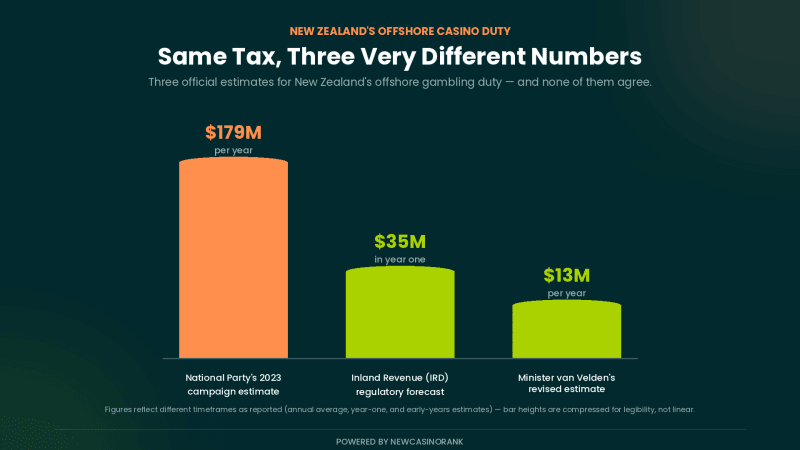
The tax was supposed to be the easy part of this reform. The tax started as a 12% duty on offshore operators' gross gambling revenue (GGR), and National campaigned on it, promising an average of $179 million a year over four years, or $719 million in total. Its yield estimate collapsed almost immediately.
A Regulatory Impact Statement from Inland Revenue (IRD) predicted the duty would raise just $35 million in year one, rising 5% annually to about $145 million in total, more than half a billion dollars short of National's number, RNZ reported. Van Velden reframed the goal rather than defend the shortfall, telling RNZ the Crown would likely see only about $13 million extra a year in the first few years, and that her real aim was balancing legal access against harm prevention, not revenue.
Then the numbers moved again, this time upward. Submissions to the select committee ran to 3,966 on the question of community funding alone. Cabinet responded by raising the duty from 12% to 16% of GGR from 1 January 2027, with the additional 4% ring-fenced specifically for community groups, an amount the government estimates at NZ$10 million to NZ$20 million a year, per Lexology's reporting. A further amendment sends 25% of the online gambling duty to the Lottery Grants Board.
The original plan asked for none of that. Martin Cheer, who runs Pub Charity's 1,700 pokie machines, put the contrast bluntly to RNZ. Class 4 gambling, the pokies, gives away effectively all of its profits under law, while the online casino model as first drafted asked licensees for nothing at all.
Enforcement built for operators who live somewhere else
The DIA built these enforcement powers for operators who have never answered to a New Zealand regulator before. The DIA can issue takedown notices, formal warnings, enforceable undertakings, and penalties up to NZ$5 million for companies, or NZ$300,000 for individual directors. Its reach is explicitly extraterritorial, closing the jurisdictional gap that let offshore casinos operate freely for two decades.
Additional rules ban credit-card deposits, prohibit affiliate marketing, and stop advertising during live sports broadcasts or within 30 minutes of one.
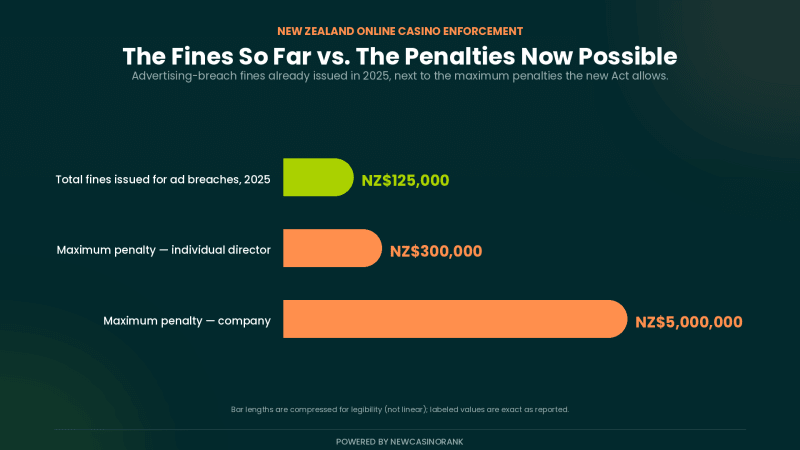
The advertising crackdown is already running ahead of the licensing timeline. In September 2025, the DIA fined four social media influencers and Curacao-based operator Spinbet a combined NZ$125,000 for breaching advertising rules, Yogonet reported. DIA Director of Gambling Vicki Scott said influencer complaints had doubled to 75 cases in 2025, with 40 influencers now on the department's watchlist, up from 24 in June. Hapai Te Hauora, a Māori health policy agency, argued the real problem sits with the casinos paying for the posts. "That's exploitation," said chief operating officer Jason Alexander.
Three lawsuits the licensing process won't wait for
Three lawsuits complicate the idea that this transition happens cleanly. Three class-action claims filed in the High Court in Auckland target offshore operators that served New Zealand. Their timing is awkward, since the defendants have also signaled interest in bidding for the licenses this litigation questions their right to have operated without.
One claim seeks funded class-action status covering player losses between February 2020 and February 2026, reportedly touching at least NZ$64.5 million in online revenue. Another defendant has formally challenged the court's jurisdiction rather than defend the claim on its merits. Justice Ian Gault has granted interim name suppression to the plaintiffs and has so far declined to consolidate the three cases into one.
None of it bars these companies from bidding. Asked directly at a select committee hearing whether litigation should disqualify an applicant, van Velden declined to draw that line. "There shouldn't be anything prohibiting somebody putting forward an expression of interest," she said, adding that eligibility depends on meeting licensing thresholds, not a company's litigation history.
The neighbor doing the opposite
Australia offers the clearest contrast available, and it is not a flattering one for symmetry's sake. Australia prohibits online casino gaming outright under the Interactive Gambling Act 2001, with no domestic licensing pathway at all, so Australians who want to play simply cross into the same offshore market New Zealand is now trying to regulate. Its Parliament passed further advertising and enforcement reforms on 19 August 2026, tightening the rules around a market it still refuses to license.
Lexology's analysis, prepared by Addisons lawyers Jamie Nettleton, Samuel Gauci, and Jak Yasuda, suggested New Zealand's experiment could eventually inform Australian policy, though political pressure to restrict gambling makes near-term change there unlikely. The two countries are running opposite experiments on the same problem.
Compared to Australia's outright ban, New Zealand's bet is that a legal, taxed pathway pulls more play out of the grey market than prohibition does. Australia is effectively betting the opposite, that no legal pathway is safer than a regulated one. Neither government has admitted it's watching the other's results, but both outcomes will get cited the moment either side needs ammunition.
What isn't decided yet
No licenses exist. No auction has happened. The 50-applicant estimate is a rumor with no DIA signature attached to it, and the tax forecasts still disagree with each other depending on who is doing the counting. What's certain is narrower than the headlines suggest. Fifteen slots, a December deadline, and three pending lawsuits from companies that plan to bid anyway. Everything else is still, quite literally, up for auction.